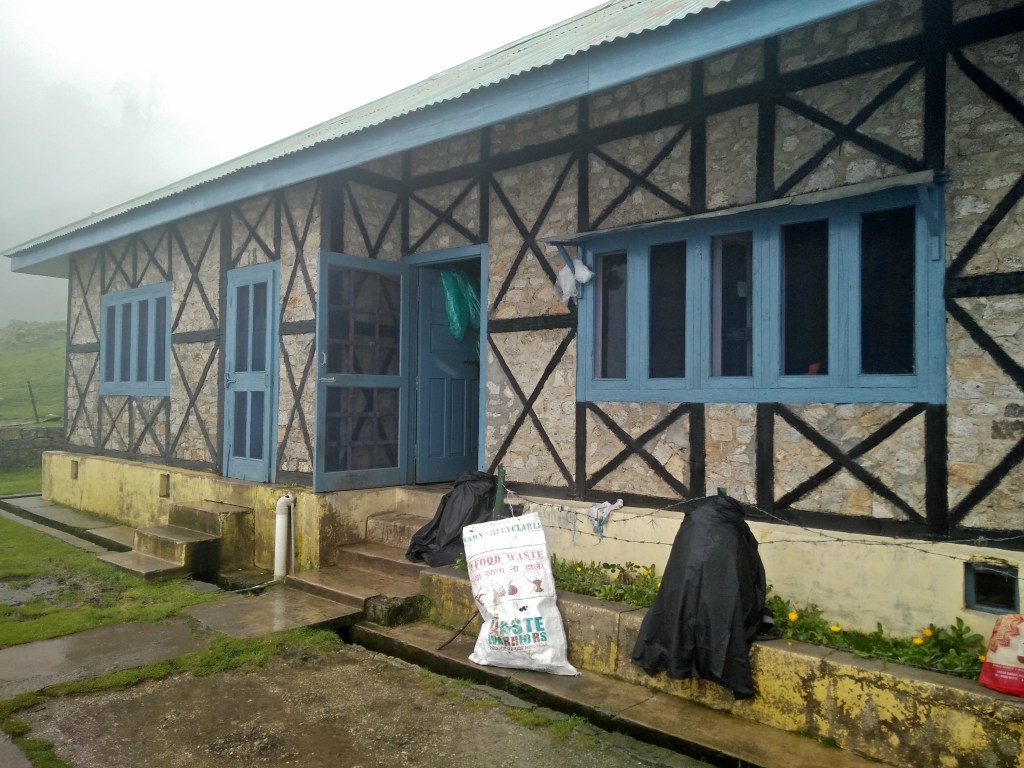
As a Structural Engineer I always try to relate whatever I study by observing the relevance in the real world. One such instance led me to a type of construction which I have learnt. After an arduous trek of 4 hours ascending from 2130m to 2850m above MSL at Triund, Dharamshala, there is a lone building of the Himachal Pradesh Forest Department.
This building is a masonry building built in a traditional construction type of the region. Popularly known as Dhajji-Dewari masonry, this type of construction is confined stone masonry with timber as confining elements. Of course, the building is made of stone masonry rather than concrete because it is difficult to transport the ingredients required for concrete, where horses and mares are the only means of transportation. But this construction is a result of engineering by our ancestors in this region. Masonry being heavy and of low strength is vulnerable to collapse under earthquakes.But the Himalayan belt is one of the locations which is highly prone to large earthquakes in the past and present due to the continuous movement of Indian plate against the Eurasian plate (about 40mm/yr).
Dhajji-Dewari masonry is a result of engineering of the people to protect their buildings from the frequently occurring minor earthquakes and occasionally occurring large earthquakes. These timber elements act as bracings to the building and divide stone masonry into smaller confined regions. Under earthquakes, buildings experience lateral forces which act perpendicular to the wall. Because the building is at rest and it is subjected to ground movement it experiences inertial forces. An analogy to understand this is the force which you experience when the bus/train in which you are standing starts to move. Masonry is very good in taking vertical forces due to gravity which generates compressive stresses in it. But very poor in resisting the horizontal forces which try to bend it and also it is brittle in failure thus collapsing without giving enough warning for the occupants. These timber elements which are provided in a grid and diagonal pattern are very good in taking compressive and tensile forces. When the building is subjected to horizontal force these members act as truss (similar to the roof which you see in malls, steel truss type bridges etc.), generating compressive and tensile forces.
Timber is very good in taking both compressive and tensile forces and also less brittle than masonry. It holds the building together like how a cardboard box is held together by sellotapes. Apart from this, these timber members also improve the performance of masonry. Masonry may be poor in resisting bending but if you reduce the length and width, it can take even higher forces. And also if you subject it to compression by some external force it can further increase its flexural strength. This is called in modern engineering term as confined masonry with sub-panelling. These subpanels can undergo damage without causing collapse of the entire structure and absorb the energy transmitted by seismic forces by undergoing damage.
I came to know about this type of construction during my graduate study at IIT Kanpur under Prof. Durgesh C Rai. He and his research group have extensively studied Dhajji-Dewari masonry and also applied it to contemporary masonry buildings. This traditional practice and symbol of engineering by our ancestors is in decline in the past few decades, as people believe reinforced frame construction is superior in terms of strength and function, which is not true given the complexity involved in earthquake resistant design, ignorance and inexperience of the builders in small to medium non-engineered residential buildings especially. Hope people are made aware of Dhajji-Dewari masonry and buildings such as this Forest Department building continue to be built in the Himalayan region.
For more information go through this publication presented in 15th World Conference on Earthquake Engineering.


 Bhushan Raj Selvaraj
Leave a comment