(This paper was written by me as part of the course CE 384T on Blast-Resistant Structural Design by Dr. Eric Williamson in University of Texas at Austin)
On the evening of 29th October 2009, a devastating explosion occurred in the petroleum oil lubricants terminal of Indian Oil Corporation (IOC) at Jaipur, India. A series of explosions occurred spreading fire to all the 11 tanks that contained petroleum products and Motor Spirit (MS). There were 11 people killed in this accident, more than 150 people injured and 5000 people evacuated from their homes (Gurjar et al. 2015). The explosions were heard up to 20 miles (32.2 km) away from the plant and windows of buildings at 1.86 miles (3 km) distance were damaged. One of the explosions created a tremor measuring 2.3 on the Richter scale by the Meteorological Department. The entire plant was destroyed and about 15.850 million gallons of petroleum products were consumed in fire, which burned for 11 days. A total loss worth US $60 million was reported. This accident was the first of its kind in India and only the second or third one reported globally. IOC formed an independent inquiry committee that collected data, identified the cause of the explosion, estimated the total loss and recommended measures to prevent such incident in the future.
Cause of Explosion
The Jaipur accident happened during a routine operation of transferring Kerosine and Motor Spirit (MS) to a neighboring petroleum terminal. While lining up the pipeline, due to “non-observance of normal safe procedure” (MoPNG Committee 2010) MS leaked from the “Hammer Blind Valve” in the form of a jet of liquid. The liquid vaporized immediately incapacitating the operators and generate a huge vapor cloud. After leaking for about 75 minutes, a massive explosion occurred followed by a fireball covering the entire plant (MoPNG Committee 2010). The evidence from site point to a non-flame proof electrical equipment in an administrative building or a vehicle being started as the possible sources of ignition that triggered the explosion. The MoPNG Committee (2010) estimated about 1100 US tons (1000 MT) of MS escaped and vaporized that could have caused an explosion equivalent to 22 US tons (20 MT) of TNT. This kind of explosion is called as Vapor Cloud Explosion (VCE), where petroleum product vaporizes forming a cloud which ignites due to a source of ignition creating blast/fire. In unconfined area, the VCE can generate a pressure front due to the fire, which moves through the cloud in speeds greater than 328 ft/s (100 m/s). Before the incident at Jaipur, massive VCE was reported in only one incident that happened at Buncefield Oil Storage Depot in UK.
Characteristics of the Explosion
MoPNG Committee (2010) modeled the leak, vapor cloud formation and explosion contours to verify the source of explosion and extent of damage. The vapor cloud spread up to 1100 ft (335 m) distance engulfing even non-plant buildings, fire-water system, truck loading facilities and portions of pipeline terminal. Johnson et al. (2012) observed high overpressures throughout the entire site which could have been due to deflagration followed by detonation based on the overpressure damage and directional indicators similar to the Buncefield incident. Based on the modeling and calculations, MoPNG Committee (2010) estimated overpressure of 1.36 psi (9.4 kPa) at distance of 656 ft (200 m) which caused partial failure of roofs, damage to window frames and doors, and failure of 25% of walls damaging the load carrying elements. At 1312 ft (400 m), the overpressure was estimated to be 0.44 psi (3 kPa) that caused minor structural damages. The overpressure contours generated by the committee indicated a shock wave of 5 psi (34.5 kPa) extending to about 252 ft (77 m) from the fire/blast.
Structural Characteristics and Damage
The IOC plant comprised of steel structures and reinforced concrete (RC) buildings. The RC buildings had masonry infill walls and concrete or steel roofs. In many RC buildings, these walls collapsed as observed in the photos of Business Continuity Centre (BCC) and Terminal Office building in Figure 1a and b. Some smaller RC buildings such as the car parking shade and smoking booth collapsed completely. Outside the plant, large industrial buildings were extensively damaged and 1.05 miles long RC boundary wall collapsed completely. The BCC building (in Figure 1a) was totally damaged with walls on the western side bulging outwards. This damage pattern, marks of thick soot and presence of ordinary electrical equipment indicated the petroleum vapors accumulated and exploded inside the building (MoPNG Committee 2010).
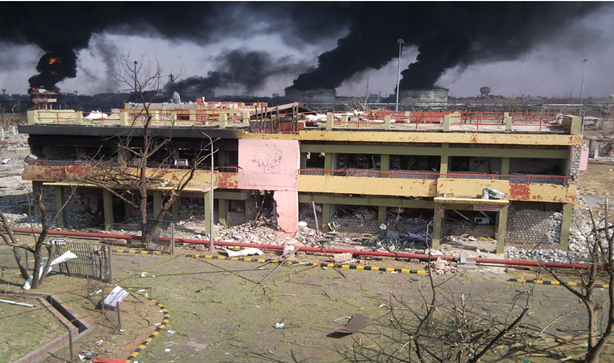
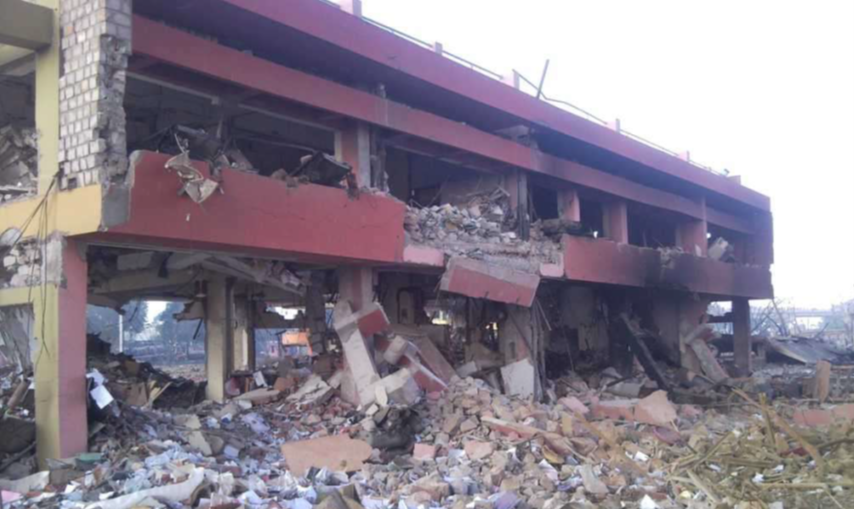
Figure 1. Structural damages observed in RC buildings; a) Business Continuity Centre (MoPNG Committee 2010); b) Terminal Office Building (Roy 2011)
There were many RC buildings in which the steel-clad roofs were damaged completely. Atkinson (2011) observed venting mechanism of failure in the warehouse buildings in Buncefield incident caused due to gradual increase of pressure attributed to sub-sonic flame front. In this failure mode, large vents are opened in the structure after which the internal and external pressures are equalized thereby preventing the progression of collapse. A warehouse at 426 ft (130 m) away from the edge of explosion in Jaipur incident had damage in the steel-clad roof but some of the walls did not fail, such as the Fire Water Pump House (see Figure 2a) and Maintenance Building (see Figure 2b). Atkinson (2011) explain that large open area failure of the roof occurred on the section closest to the explosion and the vented area increased further till it was large enough to pressurize the interior of the building balancing the exterior pressure, thereby stopping the progressive collapse of roof. This observation was based on the complete structural and cladding displacement at the front and negligible damage on the back of the roof.
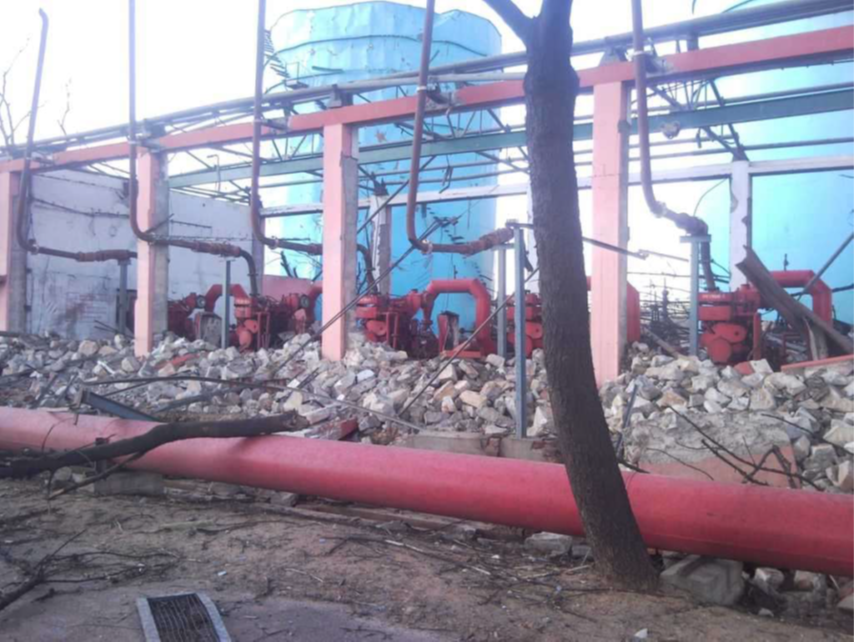
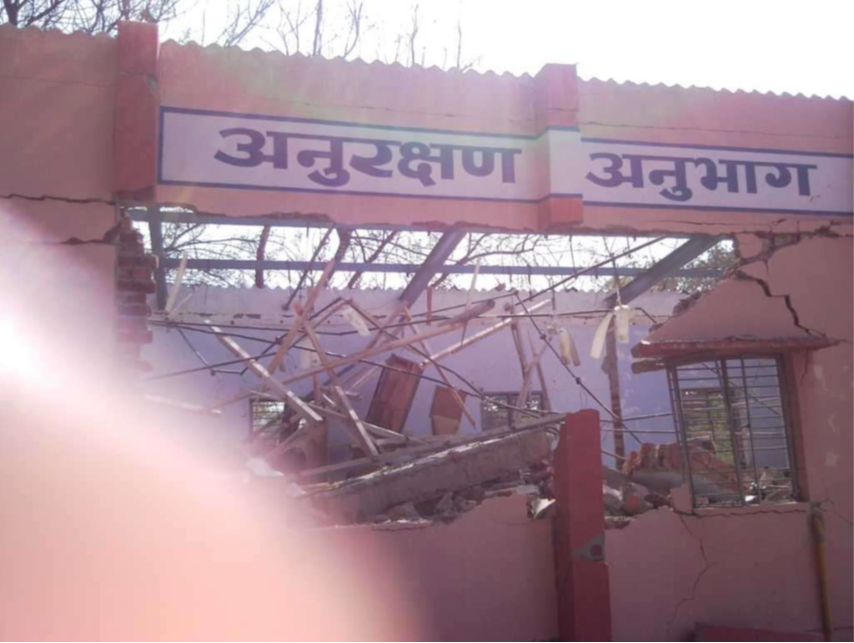
Figure 2. Structural damages observed in RC buildings a) Fire Water Pump House; and b) Maintenance Building (Roy 2011)
Steel frame buildings were damaged severely with only the distorted frames in place after the incident. The roof of tank truck loading gantry was completely blown away as observed in Figure 3a. The shells of storage tanks were heavily deformed due to the blast and fire. Floating roofs of tanks collapsed inside the shells whereas the fixed roof tanks heavily deformed and one of them had its roof blown far away. This could indicate different behavior of tanks with fixed and floating roofs. A collapsed tank with floating roof that contained large inventory of MS is shown in Figure 3b.
Lessons Learnt
The primary reasons for the Jaipur accident were unsafe operation and design of the valve. However, congestion and poor design of buildings in the plant also played a major role in this devastation. The MoPNG Committee (2010) recommended several short- and long-term measures. Some of the civil engineering recommendations included locating the control room and firefighting equipment away from the potential leak sources, designing the control room to be “blast proof” and avoiding congestion in the plant site.
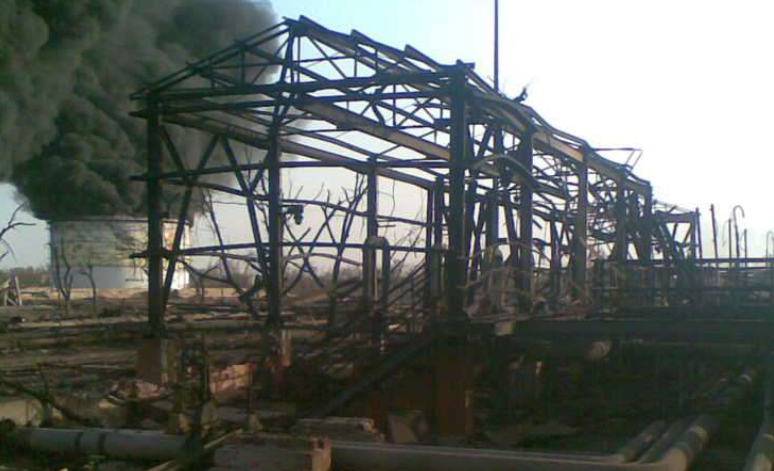

Figure 3. Structural damages observed in a) Tank Truck Loading Gantry; and b) storage tanks (Roy 2011)
References
Atkinson, G. 2011. “Blast damage to storage tanks and steel clad buildings.” Process Safety and Environmental Protection, 89 (6): 382–390.
Gurjar, B. R., R. K. Sharma, S. P. Ghuge, S. R. Wate, and R. Agrawal. 2015. “Individual and Societal Risk Assessment for a Petroleum Oil Storage Terminal.” J. Hazard. Toxic Radioact. Waste, 19 (4): 04015003.
Johnson, D. M. 2013. “Vapour cloud explosion at the IOC terminal in Jaipur.” Loss Prevention Bulletin, 229, 11–18.
MoPNG (Ministry of Petroleum and Natural Gas) Committee. (2010). “Independent inquiry committee report on Indian oil terminal fire at Jaipur on 29.10.2009.” 〈http://oisd.nic.in/index.htm〉 (Aug. 27, 2022).
Roy, S. K. (2011). “Jaipur terminal fire of 29.10.2009.” Indian Oil Corporation Limited 〈https://engineerscommunity.com/uploads/short-url/vPn0vgg2xn24jVg936dnLO8TZWQ.pdf〉 (Aug. 27, 2022).
Sharma, R. K., B. R. Gurjar, S. R. Wate, S. P. Ghuge, and R. Agrawal. 2013. “Assessment of an accidental vapour cloud explosion: Lessons from the Indian Oil Corporation Ltd. accident at Jaipur, India.” Journal of Loss Prevention in the Process Industries, 26 (1): 82–90.
 Bhushan Raj Selvaraj
Leave a comment