Anyone who interacted with me two years ago about applications of Machine Learning in Structural Engineering, this is how the conversation would have gone.
Why don’t you use Machine Learning in your field?
Machine learning needs a lot of data which we don’t have as there are several unique conditions when designing and constructing a building or a bridge.
You can come up with efficient designs, right? Or even automation?
An engineer can come up with an efficient design than a computer. I would rather see the engineers focus on the science behind it to come with up economical designs than training a computer to do it. Understanding the physics is more helpful than learning a computer algorithm. Perhaps, in your field when you are dealing with arbitrary things like identifying things in an image, it is more useful.
In two years, my views on the application of AI/ML have changed drastically. Was ChatGPT responsible for it? Well… maybe. Some people were skeptical about the writing capabilities of ChatGPT. Many still are, especially in academia. Suddenly, we are worried about the learning process, thinking that students would just ask ChatGPT the question and get the entire essay written. I can imagine how the world would have reacted when the internet was popularized or when Google was launched. I haven’t read people’s reactions from those times, but I am sure it would have been the same. When a technology disrupts the current system, people worry about how it is different from the way they used to work or learn. When I was in school, my teachers and every adult said, “You are lucky to be born at this time. You have everything available on the internet. You have good education available. You have things that make your life easy. In our times,…” And now that I am an adult, I would say the same thing to kids today. I have been more open to trying new technology, thanks to my father who always had the latest gadget and taught me to use a home computer when I was in the 5th grade (it was a huge thing to have a computer at home, especially given the economic status in which I grew up).
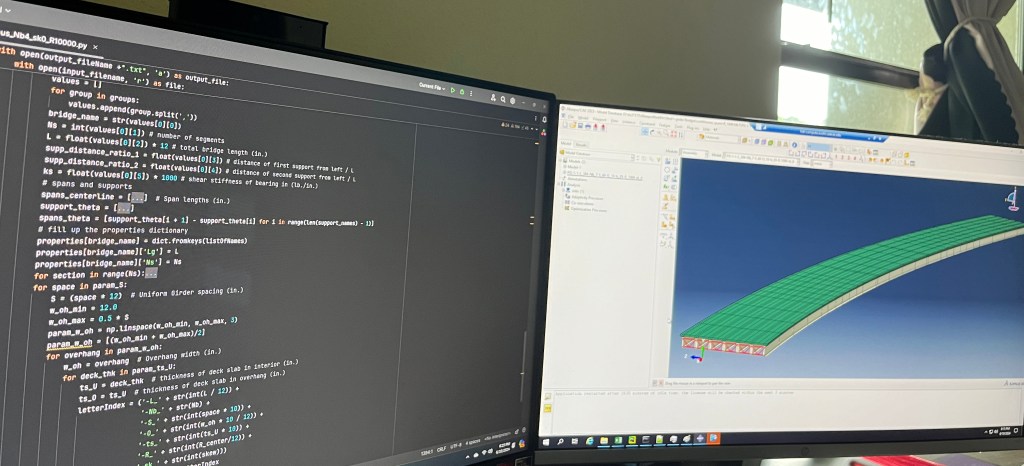
A year ago, I started learning Python to develop scripts in Abaqus so that I could develop and analyze several models quickly. I had seen some scripts from PhD students in my lab (Xianjue Deng and Esteban Zecchin) that were efficient and reduced the effort of graphically developing a model in Abaqus. Moreover, scripting is the best way to run the analysis on the supercomputers of the Texas Advanced Computing Center (TACC). I spent a lot of time learning Python, especially the aspects different from other programming languages I had learned in school or MATLAB, such as Dictionaries, List vs Tuple, Attributes, and Methods, as well as many Abaqus-specific ways of accessing items. Every time I used a new method in Python, I would search on Google, which would ultimately lead to a Stack Overflow page, and then I would adapt my code based on 3 or 4 pages with similar questions. Now, cut to the current time: I go to ChatGPT, explain what I am trying to do, and ask for a way to accomplish it in Python. In a few seconds, it teaches me how to do it and gives an example that I can modify according to my requirements. If there are any difficulties, I ask it to improve the code further. What used to take me several hours is now done in a few minutes, and I learn more. Especially with programming as a Structural Engineer, I don’t need to be an expert in writing the most efficient, beautiful code. But the improvement in my productivity is much higher, and it increases the quality of my work. Now, with this script, one can generate an Abaqus model of a steel or concrete I-girder bridge, straight or curved, with normal or skewed supports, and flexible or rigid supports within minutes.
Just two days before writing this blog, I had to do some calculations in Excel that had to be repeated several times with different inputs. I was designing a deck slab for different railings (crash barriers) and overhang widths. Six years ago, I would have known how to do it using Macros and some Visual Basic programming. But now, I only know how to use Macros. I knew it could be done in VB code easily. So this is what I did: I recorded a macro, performing operations for one calculation. It was just copying the input and pasting it into the calculation and then getting the output and pasting it into a table. I copied the VB code the macro recorded, put it in ChatGPT, and asked it to give me the same code for doing it over 5 input values. I thought ChatGPT was going to copy the code and replace the cell values. But what ChatGPT gave me was a clean 4 lines of VB code using for loops. Now I know where to change the values to modify the code to suit my requirements. I also asked ChatGPT to create a nested for loop for a two-parameter input. I might have spent almost 2 hours learning to do this or doing some boring copy-paste-modify work to accomplish this task. In the end, all it took was 1 minute with ChatGPT. At this point, I went into adult mode, “In our times,…” A few years back, I was trying to develop an Excel sheet that could generate the input file for STAAD analysis of a curved girder-slab bridge. I spent several days developing that when I had time to do it at work. I can imagine how much time I might have saved if I had ChatGPT at that time.
The key point here is, I learned the basics of Python and VB before using AI to solve problems. So AI is not going to take away the learning part. You still need to be good in the basics and be in learning mode when using AI applications. You need to be knowledgeable to adapt the results of AI to your work to improve on it. It is just a tool that makes our work more productive and efficient.
The day I turned completely in favor of using AI/ML in Structural Engineering was after listening to Robert Otani of Thornton Tomasetti at the 2024 Steel Conference (NASCC) in San Antonio, TX. The room was filled with people, and many of them were even standing to listen to this lecture. All because AI and ML are buzzwords, and the construction industry was pleased to hear from one among them. After his talk, I came out of the room amazed at the future of Structural Engineering. I will try to explain some of them here.
The first problem with using Machine Learning is that you need to have a lot of data. My interpretation of this was that you need to collect all your designed structures and all the variables involved in them. But Otani’s solution for this was using synthetic data. His company had programs that could be used to analyze and design trusses, beams, columns, and frames according to the codes of practice. Now, with these programs, they can automatically generate thousands of designs for various combinations of design parameters or geometries. The problem of large data is solved. Most of us who have worked in a design firm would have developed or used design sheets to carry out this task. Any of us can generate the data by iterating with different inputs.
The second one is using various machine learning tools to generate a predictive model. Here is where the technicalities of algorithms are involved. Let’s skip this part or leave it to computer scientists to do this. However, we need to know which model to use for a specific purpose. Otani showed how they could come up with designs for minimum cost or carbon cost (I cannot recollect exactly what this sustainability parameter was). An optimization program for the design of a particular member would take several minutes to come up with a solution, but the ML program could do it in a few seconds, though not perfect, but close enough. The biggest impact is in the application for large-scale systems. Say you are designing a building for the conceptual design stage or for tendering purposes. You don’t need a perfect design at this stage. Now this ML program can come up with several designs and choose the best one based on your requirements. For example, if you want to identify column positions for a building, the program can come up with workable solutions. The same task done by an engineer takes several hours to analyze each solution. This could be done by an experienced engineer in a few minutes. Now this ML program is enabling a less experienced engineer to make their work faster and more efficient. Of course, the engineer should be knowledgeable enough to verify if the solution is sensible.
I have worked on tenders for Engineering, Construction, and Procurement (EPC) projects in India, also called Turnkey Contracts, in which contractors are responsible for the preliminary design. The contractor’s engineer needs to come up with the most optimized designs to quote the lowest cost to the client in order to win the project. I had spreadsheets to calculate the design forces approximately and design the members to come up with quantities. In general, this would take a lot of time to analyze for different parameters, say pier/bent diameters. Usually, experienced engineers adjust these designs based on their rules of thumb or past experience. If you have an ML program that can give you the structural solution and the cost associated with it, the engineer would have more time to play around with alternative solutions. It is possible to generate synthetic data with the simple preliminary design sheets. It needs a team of structural engineers and computer engineers who can put together a program building on each other’s experience.
Robert Otani also presented an application of a Large Language Model (LLM). They had an engineer with more than 30 years of experience who retired recently. The company engineers used to go to him to seek his advice on issues at the site, and his suggestions were valuable. Structural engineers who have worked in the industry know such a person in their lives too. TT’s team was given permission to use the emails of this experienced engineer to train an LLM like ChatGPT. This program can now answer any of your questions in the same way the retired engineer would respond to them. The engineer was not alive when this program was developed fully. His experience is tapped even beyond his lifetime. Now imagine how much knowledge is lost when people retire or change companies. Many engineers hardly have time to document their learning. The future looks bright to me in this regard, but we need to keep in mind that it should be used responsibly.
In the Fall of 2023, I took a course on Scientific Machine Learning at UT Austin taught by Dr. Krishna Kumar. I was always keen to take a course on ML but was scared of the maths involved and programming knowledge necessary. As I got comfortable with using Python by that time and since it was a civil engineering professor teaching the course, I took it. Dr. Kumar made it easy for me to understand the concepts broadly, if not deeply. I could see the potential of using it in Structural Engineering when I learned about Physics-Informed Neural Networks (PINN), which can be constrained to learn physics and then predict. Inverse problems could be used when we predict information about a structure based on measurements. I know several researchers working on such applications, but this was all new to me, coming from the industry approach to engineering.
Now, coming to the impact on jobs, should we be worried about our jobs? I would say “No,” which was my takeaway from Otani’s presentation too. If we as Structural Engineers leverage AI in our work just like we use software and programming, our jobs are safe. Even now, I hear some complaints that engineers are too reliant on finite element analysis software. If we are using a tool for designing a structure, people’s lives depend on us. We should ensure that whatever tool we use ultimately results in a safe structure. No software or AI tool can do this and replace a Structural Engineer. There are fewer engineers with good experience, and they do not have time to teach or supervise young engineers. The current AI revolution should be capitalized by young engineers using it as a tool rather than a solution. There is still a lot more to learn about the behavior of structures. Just like how engineers used calculators to reduce their time spent on manual calculations, we would be using AI and ML tools to reduce our time spent on some time-intensive, laborious tasks.
P.S.: Regarding the issue of students using ChatGPT for assignments, I believe instructors need to devise creative and personalized questions. This could involve allowing students to choose their topics or making the assignments more research-intensive. For instance, if I were teaching a Structural Analysis course, I would ask students to select a structure from their surroundings and analyze a portion of it. This approach ensures they learn the concepts and use AI tools to enhance their work, similar to the tasks they will perform as professional engineers. My essay on Vapor Cloud Explosion in a petrochemical plant in Jaipur stemmed from a similar assignment prompt in the Blast Design of Structures course. Check that out, if you are interested.
This blog turned out to be longer than I expected. To save your time, I asked ChatGPT to generate a TL DR summary. Also, this post was edited by ChatGPT.
TL DR:
- Evolving Views on AI/ML in Structural Engineering: Initially skeptical about ML due to data constraints and unique design conditions, my perspective shifted after seeing practical applications and efficiency gains, particularly influenced by ChatGPT.
- Increased Productivity with AI: Learning Python and Visual Basic basics allowed me to use AI tools like ChatGPT for programming tasks, drastically reducing time spent on repetitive work and improving overall productivity.
- Future of Structural Engineering with AI: Inspired by Robert Otani’s presentation and a Scientific Machine Learning course, I see AI as a valuable tool for optimizing design processes and preserving expert knowledge, enhancing rather than replacing the role of engineers.
 Bhushan Raj Selvaraj
Leave a comment